
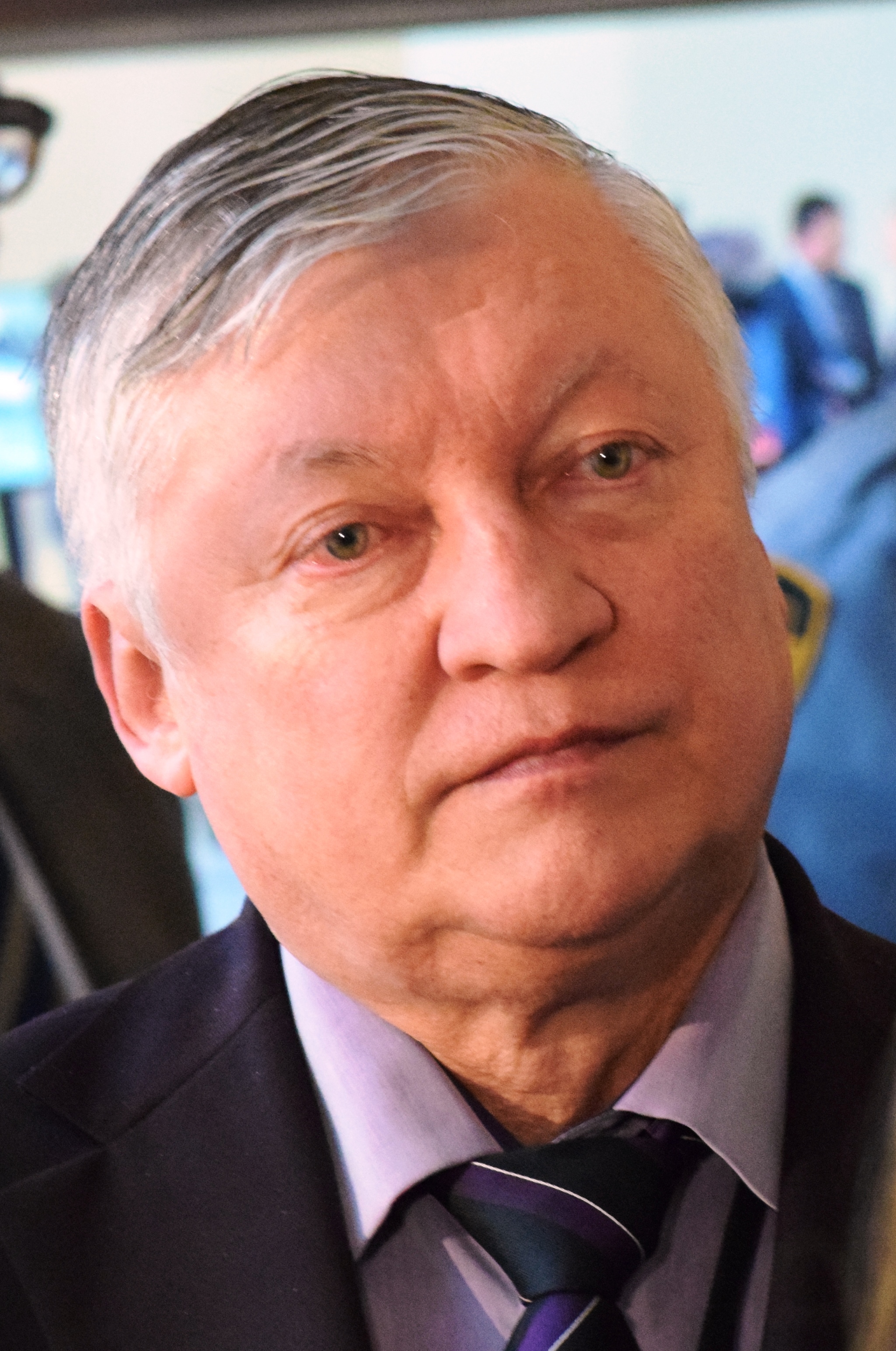
Anatoly Karpov is one of the greatest chess players in history, World Chess Champion from 1975 to 1985, and again under FIDE from 1993 to 1999. The Russian Grandmaster spent a decade at the absolute pinnacle of the game, defending his title twice against Viktor Korchnoi before facing Garry Kasparov in five grueling matches that defined an era. His peak FIDE rating of 2780 and over 160 first-place tournament finishes make him, by sheer volume of victories, the most decorated competitive chess player who ever lived.
Career Overview
| Detail | Value |
|---|---|
| Full name | Anatoly Yevgenyevich Karpov |
| Born | May 23, 1951, Zlatoust, Soviet Union |
| FIDE ID | 4100018 |
| Title | Grandmaster (GM) |
| Peak FIDE rating | 2780 (July 1994) |
| World Champion (undisputed) | 1975–1985 |
| World Champion (FIDE) | 1993–1999 |
| Tournament first places | 160+ |
World Championship Record
1975: World Champion by default
Karpov became World Chess Champion on April 3, 1975, without playing a single game. The reigning champion, Bobby Fischer, refused to defend his title under FIDE’s match conditions and was stripped of the championship. Karpov, who had qualified through the Candidates cycle, was declared champion.
The circumstances were complicated. Many questioned whether a title won by default could carry the same weight. Karpov spent the next decade erasing that doubt, first by dominating world chess completely, then by winning two matches against the strongest challenger of the late 1970s.
“I wanted to prove that I deserved the title over the board,” Karpov said in later interviews. “Fischer’s refusal was his decision. My job was to show the chess world that the champion was the best player.”
1978 and 1981: The Korchnoi matches
Viktor Korchnoi was the strongest challenger Karpov faced in his first reign. A defector from the Soviet Union, Korchnoi carried enormous political weight into the match at Baguio City, Philippines, in 1978. It became one of the most tension-filled championship contests in chess history, running 32 games over five months.
Karpov won 6-5 (with 21 draws). The match was decided on the final game, Korchnoi needed a win to level the score and instead resigned in a lost position.
The 1981 rematch in Merano, Italy, was less close. Karpov won convincingly, 6-2 with 10 draws. He was 30 years old and at the height of his powers.
1984–1985: The Kasparov marathon and the title lost
The rivalry between Anatoly Karpov and Garry Kasparov produced five World Championship matches between 1984 and 1990, more championship games between two players than any other pair in chess history.
The first match, in Moscow in 1984, was unlike any other in the modern era. It was played under the old unlimited-games format: the first player to win six games would be champion. After 27 games, Karpov led 5-0 and appeared on the verge of the fastest championship victory since the 1920s. Then something shifted. Kasparov dug in. He drew 17 straight games. He won games 32 and 47. The match stretched to 48 games over five months before FIDE President Florencio Campomanes controversially terminated it, citing player health, with the score 5-3 in Karpov’s favor. No winner was declared.
The rematch in 1985 was 24 games. Kasparov won 13-11, the first decisive game being on move 47 of Game 16. Karpov lost his title after a decade as champion. He was 34 years old.
Follow the Candidates Tournament history to understand how both players navigated the qualification cycle across three decades.
Playing Style
Karpov’s chess is built on the concept of prophylaxis, preventing your opponent’s plans before they materialize, removing resources, tightening space. Where Kasparov created chaos and fought for the initiative, Karpov was content to let the position become slightly uncomfortable for his opponent and then squeeze.
Grandmaster Garry Kasparov, reflecting on their rivalry, described Karpov’s method this way: “Karpov doesn’t create complications, he eliminates them. He removes your pieces, your space, your counterplay, and by the time you realize you have nothing left, he’s already won.”
The “boa constrictor” label emerged from this style. Karpov’s endgames were particularly precise: he could convert small structural advantages that most GMs would hold as draws. His technique in rook-and-pawn endings was considered the best in the world through the 1980s.
His openings favored closed and semi-closed positions, the Queen’s Indian, the Caro-Kann, the English Opening with White. He avoided the sharp lines that Kasparov preferred and steered games toward positions where small differences in piece activity and pawn structure would decide everything over 60 or 70 moves.
For a direct contrast, see how Magnus Carlsen’s dominance in endgame technique draws a direct line from Karpov’s school of positional chess.
Major Tournament Victories
Karpov won more chess tournaments in his career than any other player in history. The commonly cited figure is over 160 first-place finishes, which is roughly double Kasparov’s total over a comparable career span.
His most significant supertournament victories include:
- Linares (the strongest annual supertournament through the 1980s and 1990s): multiple wins in an era when finishing in the top three meant competing against Fischer, Kasparov, Korchnoi, Spassky, and the strongest Soviet players
- Tilburg Interpolis and Montreal 1979: back-to-back dominant performances in the late 1970s that established him as the world’s best active player even before the Korchnoi matches were settled
- FIDE World Champion 1993–1999: after the PCA/FIDE split in 1993, when Kasparov and Nigel Short broke away to contest their own championship outside FIDE, Karpov beat Jan Timman to claim the FIDE title. He held it until losing to Viswanathan Anand in the 1998 FIDE World Championship knockout tournament in Lausanne.
His tournament record across the 1970s and 1980s was essentially unbroken dominance. In many years, he was the first or second seed at every significant event he entered and finished in first or second at nearly all of them. The volume of victories is the clearest statistical argument for placing him in the conversation for greatest chess player of all time.
Check the current FIDE top player ratings to see how today’s elite compares to Karpov’s peak 2780 Elo in a modern rating context.
Legacy
Anatoly Karpov’s legacy sits in an unusual place. He is objectively one of the two or three greatest players in chess history by any measurable standard, yet the Kasparov rivalry has often defined how he is remembered, as the player Kasparov eventually overtook, rather than as a ten-year dominant champion in his own right.
The rating context matters here. Karpov’s peak of 2780 in July 1994 came when the rating scale was more compressed than it is today. In the modern era, the top players routinely exceed 2800; in Karpov’s prime, the upper boundary of possible ratings was effectively lower. Adjustments for era place Karpov’s peak performance among the highest ever recorded.
His influence on modern chess is direct. The positional school he represented, patient maneuvering, prophylactic thinking, endgame precision over tactical fireworks, runs through every player trained in the Soviet tradition. Magnus Carlsen, who studied Soviet chess deeply, cites positional mastery as the foundation of his own game. Karpov’s style is part of that tradition.
The comparison to players like Judit Polgar and the generation that followed illustrates how deeply Soviet chess shaped the modern game’s technical standards, Karpov was among the definitive figures of that tradition.
In 2026, Karpov is in his mid-70s, largely retired from competitive play. He has served as a member of the Russian State Duma. His FIDE profile remains active at ratings.fide.com/profile/4100018. His full biography is documented on Wikipedia and his games are available for study on Chess.com.
For anyone learning chess in 2026, Karpov’s tournament games remain among the best available studies in positional chess, prophylaxis, and endgame conversion. The techniques he demonstrated across 160+ first-place finishes have not been superseded.
Related Articles
- Magnus Carlsen player profile, how Carlsen extended the positional school
- Judit Polgar chess profile, the player who redefined women’s chess in Karpov’s era
- Candidates Tournament history and past winners, the qualification route Karpov won in 1974
- What is the Candidates Tournament?, the format that shaped championship chess
- Current FIDE top player ratings, where today’s elite stands
Frequently Asked Questions
How many times was Anatoly Karpov world champion? Karpov was undisputed World Chess Champion from 1975 to 1985, a ten-year reign. He was also the FIDE World Champion from 1993 to 1999 after the PCA/FIDE split, for a total of two separate championship reigns.
What was Karpov’s peak FIDE rating? Karpov’s peak FIDE rating was 2780, reached in July 1994. This made him the highest-rated active player in the world at that time and remains one of the highest ratings ever recorded relative to the era.
How did Karpov become world champion in 1975? Karpov qualified for the championship match through the 1974 Candidates Tournament, winning it to earn the right to face Bobby Fischer. Fischer refused to play under FIDE’s proposed match conditions and was stripped of his title. FIDE declared Karpov the new World Champion by default on April 3, 1975.
Who did Karpov lose his title to? Karpov lost the World Chess Championship to Garry Kasparov in Moscow in 1985, in a 24-game match. The final score was 13-11. It ended Karpov’s ten-year reign as champion.
What was Karpov’s playing style? Karpov was known for positional, prophylactic chess, often described as the “boa constrictor” style. He excelled at eliminating his opponent’s counterplay, squeezing space, and converting small advantages in endgames. He avoided tactical complications and was considered one of the greatest endgame players in history.
How many tournaments did Karpov win? Karpov won over 160 first-place finishes in international tournaments, more than any other player in chess history by a significant margin.
Is Anatoly Karpov still alive? Yes. As of 2026, Karpov is 74 years old. He is largely retired from competitive chess and has served in the Russian State Duma. He remains one of the most studied players in chess history.