
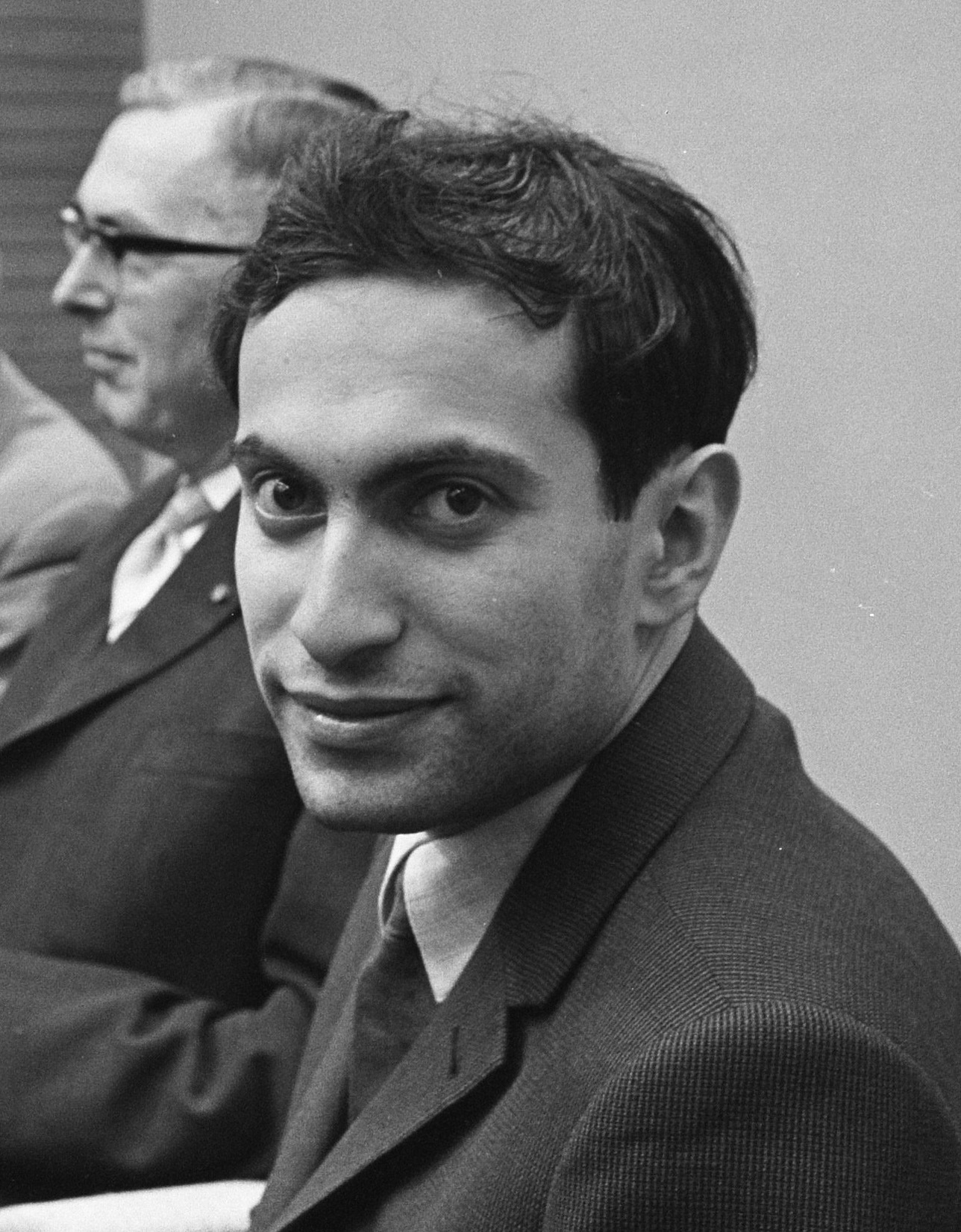
Mikhail Tal was not just a chess player — he was a force of nature at the board. Known as “The Magician from Riga,” Tal played chess the way a jazz musician improvises: with instinct, fire, and a complete willingness to abandon safety in the pursuit of something extraordinary. He was the eighth World Chess Champion, a six-time USSR Champion, and one of the most beloved figures in the history of the game. Decades after his death, his games are still studied, replayed, and marveled at by players of every level. This is the story of Mikhail Tal — where he came from, how he conquered the chess world, and why his legend endures.
Early Life in Riga
Mikhail Nekhemyevich Tal was born on November 9, 1936, in Riga, Latvia — at the time part of the Soviet Union. He grew up in a Jewish intellectual family and showed early signs of extraordinary mental gifts, reading fluently by the age of three and displaying a remarkable memory from childhood. These were documented traits that friends and family described consistently throughout his life.
Tal learned chess at the age of eight and quickly demonstrated a talent that went far beyond normal prodigy development. He was drawn not to the careful, systematic style that dominated Soviet chess at the time, but to wild, chaotic positions where calculation alone couldn’t save you. By his mid-teens, he was already a force in Latvian chess, and by his early twenties, the entire Soviet Union had taken notice.
What separated the young Tal from his peers wasn’t just raw tactical skill — it was psychological. He understood intuitively that chess is played by human beings, not computers, and that a position which creates fear and confusion in the opponent is worth more than a technically sound line that leads to a quiet draw. This insight would define his entire career.
Rise to the Top: Road to World Champion
Tal’s ascent through Soviet chess was rapid and stunning. He won his first USSR Championship in 1957 at just 20 years old, announcing himself as a genuine contender on the world stage. He would go on to win the Soviet Championship six times in total — a remarkable achievement in a country that was, at the time, the undisputed powerhouse of world chess.
The path to challenging for the World Championship ran through the Candidates Tournament, the grueling series of matches and round-robins that determines who faces the reigning champion. Understanding how the Candidates Tournament works is essential context for appreciating how steep Tal’s climb was. He qualified for and dominated the 1959 Candidates Tournament in Yugoslavia, finishing first with 20 points out of 28 — a full 1.5 points ahead of a field that included future World Champions Vasily Smyslov, Paul Keres, and Bobby Fischer. His play was so aggressive and unpredictable that opponents simply couldn’t prepare for him effectively.
For a full account of how the Candidates system has evolved from Tal’s era to today, the history of Candidates Tournament winners traces every cycle back to 1950. Tal’s 1959 performance remains one of the most dominant runs in the event’s history.
The 1960 World Chess Championship vs Botvinnik
In 1960, Mikhail Tal faced the reigning World Champion, Mikhail Botvinnik, in Moscow. It was one of the most anticipated title matches in chess history — youth, chaos, and fire versus the iron discipline of the “Patriarch of Soviet Chess.”
Botvinnik was everything Tal was not at the board: methodical, deeply prepared, and a master of technical endgames. He had held the world title on and off since 1948 and was widely considered unbeatable on home turf. The conventional wisdom was that Tal’s swashbuckling style, however spectacular in open tournaments, would collapse under the clinical preparation Botvinnik would bring to a 24-game match.
It did not collapse. Tal won the match 12.5–8.5, taking the World Championship title at just 23 years old — the youngest World Champion in history at that point. His victories were characterized by the same sacrificial complexity that had overwhelmed opponents in the Candidates: positions that looked unsound by computer standards but were humanly impossible to navigate under time pressure, with the psychological weight of a world title match bearing down. Botvinnik, famously one of the most stoic champions ever to hold the title, admitted he had found Tal’s style deeply unsettling to face.
Tal’s coronation was a cultural moment in the Soviet Union. He was celebrated not just as a chess champion but as an artistic personality — someone who had brought creativity and spectacle back to the world’s most cerebral game.
Losing the Crown: 1961 Rematch
Botvinnik, under the rules of the era, had the right to an immediate rematch. He used the intervening year to prepare more methodically for Tal’s style than perhaps any player had ever prepared for an opponent. He studied Tal’s games exhaustively, identified patterns in the sacrifices, and developed ways to decline complications without ceding strategic ground.
The 1961 rematch was a different story. Botvinnik won convincingly, 13–8, reclaiming the world title. Complicating matters, Tal had been dealing with serious kidney problems throughout this period and underwent medical treatment that significantly weakened him physically. He was not at full strength for the rematch, and Botvinnik — at his clinical best — was simply too prepared and too steady to be overwhelmed a second time.
Losing the crown at 24 was a blow, but it did not diminish Tal’s standing in the chess world. He remained one of the top players on the planet for the next three decades, competing at the highest levels despite chronic illness that would have ended most careers entirely.
Playing Style: The Magician’s Secrets
Tal’s playing style is perhaps the most discussed and analyzed in chess history — and also the most difficult to imitate. He was a tactician and attacker without peer, but to describe him simply as “aggressive” misses the deeper point.
What made Tal genuinely dangerous was his psychological approach to the game. He understood that the board is only half of chess. The other half takes place in the opponent’s mind. By creating positions of maximum combinational complexity — branching tactical trees where even the best move was unclear and where a single misstep meant catastrophe — Tal placed an unbearable burden on the human being sitting across from him.
His piece sacrifices were legendary. Tal would offer a knight or bishop, sometimes two pieces, for compensation that was difficult to quantify: initiative, activity, the threat of threats. When opponents tried to calculate their way out, the variations branched into near-infinite possibility. Under tournament time pressure, facing those piercing, unblinking eyes across the board, opponents would crack.
Tal described his own philosophy with characteristic wit:
“You must take your opponent into a deep dark forest where 2+2=5, and the path leading out is only wide enough for one.”
He was equally honest about the nature of his sacrifices:
“There are two types of sacrifices: correct ones and mine.”
It was a joke, but it contained a serious truth. Tal’s sacrifices were often intuitive rather than fully calculated, and they worked because chess at its highest level is still a human game — not an engine analysis tree. His combinational genius operated in the space between what could be proven and what could be endured.
Tal also had a documented psychological effect on opponents. Multiple grandmasters reported a strange disorientation when playing against him — a sense that normal chess logic had been suspended. Whether this was the product of genuine psychological technique or the cumulative weight of his reputation, the results were consistent and undeniable.
Career Highlights Beyond the World Title
Tal’s career accomplishments extend far beyond the 1960 World Championship. He competed at the elite level for over three decades, building a record that places him among the handful of greatest players ever to live.
He won the USSR Championship six times — in 1957, 1958, 1967, 1972, 1974, and 1978 — in the strongest national chess league in the world. Soviet dominance of international chess during this era meant the USSR Championship effectively functioned as a secondary world championship in its own right, with every top-ranked player in the world competing under the same flag. Winning it six times was a career-defining achievement by any measure.
In 1988, at the age of 51, Tal won the World Blitz Chess Championship in Saint John, New Brunswick, Canada, defeating a field that included Kasparov, Karpov, and other reigning elite players. It was a remarkable demonstration that his speed, tactical vision, and psychological acuity had not faded with age or illness.
His FIDE rating peaked at 2705 in January 1980 — more than two decades after he first won the USSR Championship and nearly 20 years after his World Championship reign. That sustained peak is a testament to the quality and consistency of his play across an extraordinary career span. You can verify his historical rating data through the FIDE ratings archive.
He also competed in multiple subsequent Candidates cycles, remaining a dangerous presence in world-level chess well into the 1980s. Few players in history have maintained that standard for so long under such sustained physical adversity.
Health Battles
Throughout his career, Mikhail Tal fought a battle far harder than anything he faced across the board. He suffered from serious kidney disease for most of his adult life, requiring multiple surgeries and eventually the removal of one kidney. The physical toll was enormous — he spent periods of his career hospitalized, unable to compete, and playing through chronic pain when he could compete.
The kidney problems contributed directly to the lost rematch against Botvinnik in 1961 and affected his preparation and stamina at several other critical junctures. Rather than allow illness to define him, Tal consistently returned to chess with the same attacking fire. He played as if time were precious — because for him, it was.
He died on June 28, 1992, in Moscow, at the age of 55. He had been hospitalized again in the final months of his life, and his death was mourned throughout the chess world as the loss of one of the game’s great originals. Garry Kasparov said that Tal’s death felt like the end of an era of chess romanticism — and Kasparov, who knew both what chess greatness looked like and what chess artistry meant, was not given to sentimentality.
Legacy and Influence on Modern Chess
Mikhail Tal’s legacy is immeasurable. He demonstrated that chess could be art — that the board was a canvas for creativity, not just a battlefield for calculation. His games introduced countless players to the beauty of the game, inspiring generations who might never have fallen in love with chess through purely technical play.
His influence on chess culture extends beyond his moves. The “Tal style” — aggressive, sacrificial, psychologically oriented — became a template that players consciously studied and attempted to channel. His autobiography, The Life and Games of Mikhail Tal, remains a perennial bestseller in chess literature, introducing new generations to his genius. The complete record of his most celebrated games is preserved at chessgames.com, where annotated classics from his 1960 World Championship match are available for study.
His full biography and career record are documented on Wikipedia’s Mikhail Tal entry, which provides a thorough account of his tournament results, personal life, and historical standing.
The spirit of Mikhail Tal lives on in every player who chooses fire over safety. You can see his influence in the fearless attacking play of Alireza Firouzja, whose sacrificial instincts and willingness to court chaos echo the Magician’s approach. It lives equally in Praggnanandhaa’s tactical ferocity, whose explosive emergence at a young age mirrors Tal’s own ascent. The form changes, the names change, but the essential thing — the belief that a bold move can shatter the universe of the position — remains. That is Tal’s true legacy: not just the games he played, but the permission he gave every player who came after him to be dangerous.
Related Articles
- Garry Kasparov Chess Profile
- Bobby Fischer Chess Profile
- Candidates Tournament History & Winners
- FIDE Rating System Explained
Frequently Asked Questions
Was Mikhail Tal World Chess Champion?
Yes. Mikhail Tal was the eighth World Chess Champion, winning the title in 1960 by defeating the reigning champion Mikhail Botvinnik in a 24-game match held in Moscow. He held the title until 1961, when Botvinnik exercised the rematch right that existed under the rules of that era and reclaimed the championship.
What was Mikhail Tal’s nickname?
Mikhail Tal was known as “The Magician from Riga.” He earned this nickname because of his seemingly impossible piece sacrifices and combinational ideas that appeared to defy normal chess logic. He was born and raised in Riga, Latvia, and his style seemed to conjure victories out of positions that computer analysis would later show as objectively unsound — hence the magician label.
What country did Mikhail Tal represent?
Mikhail Tal represented the Soviet Union throughout his competitive chess career. He was born in Riga, Latvia, which was part of the Soviet Union at the time, and competed under the Soviet flag. His victories in the USSR Championship — six times in total — were achieved in the strongest national chess league in the world during that era.
What was Mikhail Tal’s playing style?
Tal was one of the most attacking and tactically aggressive players in chess history. His style centered on piece sacrifices — often intuitive rather than fully calculated — that created enormously complex positions his opponents struggled to navigate under time pressure. He understood that chess is a human game and that creating fear and confusion in an opponent’s mind is a genuine competitive weapon, not merely a side effect of good moves.
When did Mikhail Tal win the World Championship?
Mikhail Tal won the World Chess Championship in 1960, defeating the reigning champion Mikhail Botvinnik in a 24-game match. He was 23 years old at the time, making him the youngest World Champion in history at that point. His victory was celebrated as a cultural moment in the Soviet Union, where he was seen as an artistic personality who had brought creativity back to competitive chess.
Who did Mikhail Tal defeat for the World title?
Mikhail Tal defeated Mikhail Botvinnik, the reigning World Champion and one of the most respected and feared players in Soviet chess. Botvinnik was known as the “Patriarch of Soviet Chess” and was considered methodical, deeply prepared, and almost unbeatable in match play. Tal won 12.5-8.5, stunning the chess world with a performance built on sacrificial complexity and psychological pressure.
When did Mikhail Tal die?
Mikhail Tal died on June 28, 1992, in Moscow, at the age of 55. He had suffered from chronic kidney disease throughout his adult life, requiring multiple surgeries and eventually the removal of one kidney. Despite these serious and debilitating health challenges, he continued competing at elite level for decades before his death following complications from his long-standing kidney condition.
What is Mikhail Tal’s FIDE ID?
Mikhail Tal’s FIDE ID is 801550. His historical rating data and career record are available at ratings.fide.com/profile/801550, which documents his peak rating of 2705 and his competitive history.
Why is Mikhail Tal considered a chess legend?
Mikhail Tal is considered a chess legend for two interconnected reasons. First, his results were genuinely extraordinary: he became World Champion at 23, won six USSR Championships in the world’s strongest national league, and remained an elite competitor for over three decades despite chronic illness. Second, his style was unlike anything the chess world had seen — his sacrificial attacks and psychological mastery introduced a dimension of creativity and artistry that transformed how people understood what chess could be.
Where can I study Mikhail Tal’s games?
Mikhail Tal’s games are extensively documented at chessgames.com, where annotated classics from his 1960 World Championship match are available for study. His autobiography, “The Life and Games of Mikhail Tal,” remains a perennial bestseller in chess literature and is the definitive primary source for understanding both his games and his thinking about chess as an art form.