


The word “chess” is a corruption of a word you know. Every time someone says “checkmate,” they are saying “shah mat” in Persian: the king is helpless. Every time they say “chess,” they are using a shortened form of “shatranj,” the name the Persian Empire gave to a game they received from India roughly 1,400 years ago.
That game came from the subcontinent. It traveled west along trade routes, changed hands across empires, and picked up new rules at every stop. By the time it reached medieval Europe, it had been transformed almost beyond recognition. But the word stayed. “Shatranj” survived in the Arabic “al-shatranj,” crossed into Spanish as “ajedrez,” and reached English through a different path as “chess.” Both words come from the same root.
This is the history of that journey.
Chaturanga: Chess Begins in India
The earliest form of the game is called chaturanga (Sanskrit: चतुरङ्ग), meaning “four divisions of the military.” The four divisions referred to the branches of an Indian army: infantry (foot soldiers), cavalry (horses), elephants, and chariots. Each one became a piece on the board.
 Photo: Nichalp, CC BY-SA 2.5 via Wikimedia Commons
The game is generally dated to the Gupta Empire, somewhere around the 6th century AD, though some scholars place its origins even earlier. It was played on an 8x8 grid called an “ashtapada,” the same board dimensions used in chess today.
The pieces were:
- Raja (king), moved as today’s king
- Mantri (minister/advisor), moved only one square diagonally, far weaker than the modern queen
- Ratha (chariot), moved as today’s rook
- Gaja (elephant), moved two squares diagonally, jumping over pieces; roughly analogous to today’s bishop
- Ashva (horse), the L-shaped knight move, unchanged to this day
- Padati (foot soldier), moved as today’s pawn, but without the double first-move option
Two features separate chaturanga from modern chess. First, there was no queen as we know it. The mantri was the weakest major piece on the board, not the strongest. Second, some versions of chaturanga used dice to determine which piece moved each turn, blending strategy with chance.
The pure two-player, strategy-only version of chaturanga is what eventually traveled westward and became the game we recognize.
“Chess is one of humanity’s oldest intellectual games, born in India as chaturanga and carrying the fingerprints of every civilization it passed through. The pieces on a modern board are living artifacts of a 1,500-year journey.” — H.J.R. Murray, chess historian and author of A History of Chess (1913)
From India to Persia: The Birth of Shatranj
Around 600 AD, during the reign of the Sasanian Emperor Khosrow I, the game arrived in Persia. Persian sources record the visit of an Indian ambassador who brought chaturanga as a diplomatic gift, presenting it as a puzzle: could the Persians figure out the rules by observation alone? The royal court accepted the challenge, decoded the game, and the Persians created their own version.
They called it chatrang, which later became shatranj (شطرنج). The pieces kept their functions but received new Persian names. The raja became the shah (king). The mantri became the farzin (counselor). The ratha became the rukh (rook, a word that survives directly into English). The gaja became the pil (elephant). The ashva became the asp (horse). The padati became the piyade (foot soldier).
The rules were nearly identical to chaturanga, with one critical difference: dice were dropped entirely. Shatranj became a game of pure strategy. Every outcome was the direct result of the player’s decisions. This was the version that would shape all subsequent chess.
Persian literature embraced shatranj. The epic poem “Wizarishn i chatrang” recounts the origin story in detail. The Shahnameh of Ferdowsi, written around 1010 AD, includes extended passages about shatranj as a game of kings and intellectuals. The image at the top of this article is from the Bayasanghori Shahnameh, a 15th-century illuminated manuscript now held in Tehran. It depicts a shatranj match in the royal court.
The term “checkmate” comes directly from this period. When the king had no escape, a player declared “shah mat” (شاه مات): the king is helpless, defeated, at a loss. That phrase traveled unchanged through Arabic, Spanish, Old French, and into English.
The Arab Transmission: Al-Adli and As-Suli
When the Islamic caliphate conquered Persia in the 7th century, shatranj passed into Arab hands. The Arab world did not just adopt the game. It theorized it. In the 9th and 10th centuries, Arab scholars wrote the first systematic chess treatises ever produced.
Al-Adli (c. 840 AD) wrote “Kitab ash-Shatranj” (Book of Chess), classifying openings, analyzing endgames, and ranking players by skill level. He is considered the first person to document chess theory in any form.
As-Suli (c. 920 AD) was considered so strong that “strong as as-Suli” became a standard Arabic compliment for a player’s skill for centuries after his death. His analysis of knight tours and endgame positions was not improved upon in the Arab world for hundreds of years.
Two Arabic innovations stand out from this period. First, Arab players developed the concept of murabbaa, a study position designed specifically for teaching. These were essentially chess puzzles, the ancestor of the composed problems printed in newspapers today. Second, Arab manuscripts began recording specific games for posterity, a practice that created the first chess game database.
The Abbasid Caliphate spread shatranj from the Middle East to North Africa and into Spain, where it arrived with the Moorish conquest in the 8th century. It also spread east, through Central Asia and into the regions that are now Uzbekistan and Afghanistan. The city of Samarkand became a center of chess culture, a tradition that has roots stretching back over a millennium before any modern championship.
How Chess Reached Medieval Europe
Chess entered Europe through three main channels between the 9th and 12th centuries.
Spain received the game earliest, through the Moorish presence in Al-Andalus. The Alfonso X manuscript “Libro de los Juegos” (Book of Games), completed around 1283, contains the oldest surviving European chess illustrations and records games played at the Spanish court. The Spanish word “ajedrez” comes directly from Arabic “al-shatranj.”
Sicily was a second entry point, via Norman contact with Arab culture in the Mediterranean. Chess sets made in Sicily in the 11th and 12th centuries survive in European museum collections.
The Crusades brought the game to northern Europe as returning knights carried sets from the Levant. England, France, and Germany had established chess cultures by the 13th century.
The most famous physical artifact of medieval European chess is the Lewis Chessmen, carved from walrus ivory, found on the Isle of Lewis in Scotland and dated to the 12th century. They are now split between the British Museum in London and the National Museum of Scotland in Edinburgh.
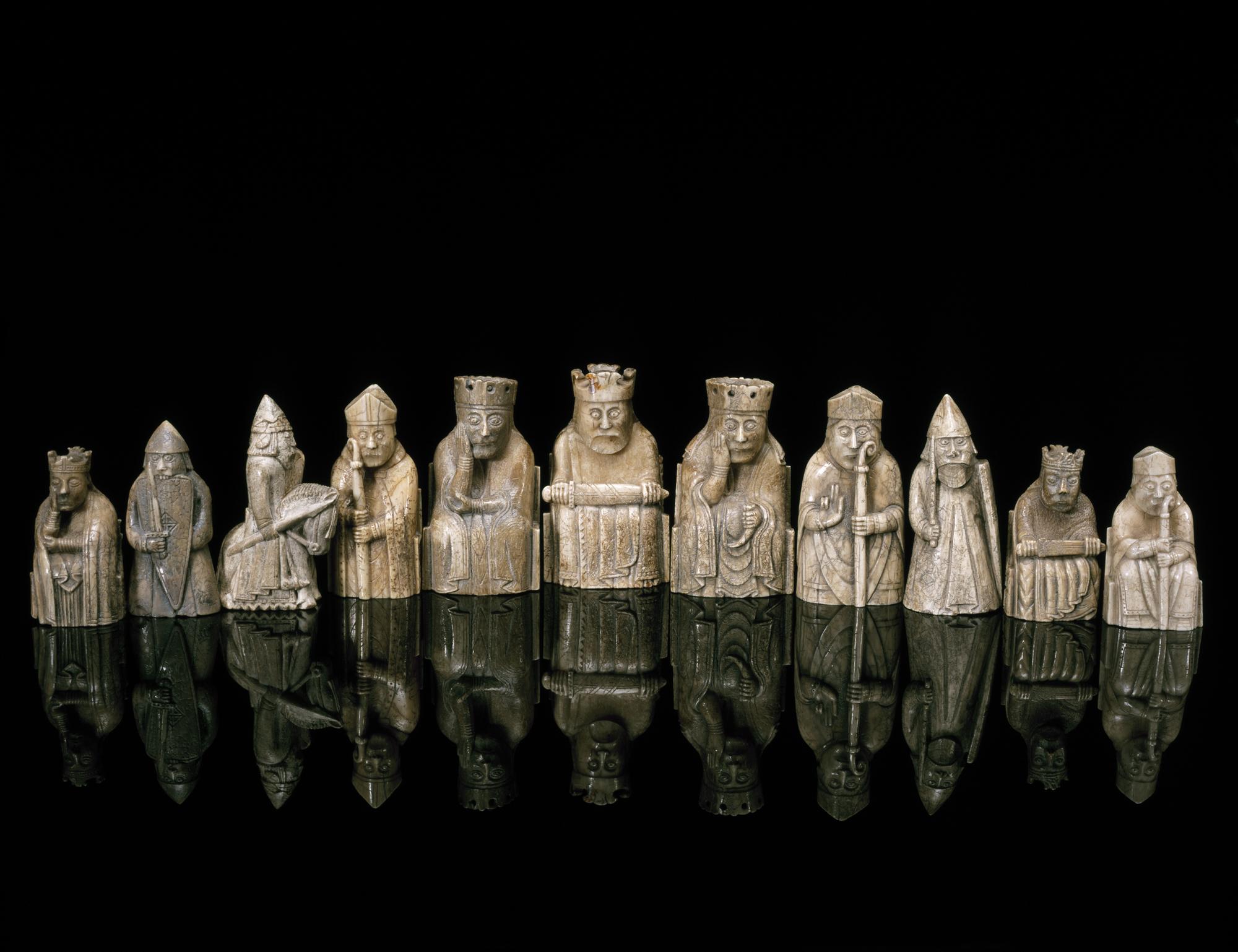 Photo: Andrew Dunn, CC BY-SA 2.0 via Wikimedia Commons
The Lewis pieces show the game in transition. The “firzan” or counselor figure is depicted as a queen on a throne. But the piece still had limited powers: one square diagonally per move, the weakest major piece on the board, just as in shatranj.
Shatranj vs Modern Chess: The Key Differences
If you sat down to play shatranj today, you would recognize the board and the objective immediately. But the game would feel almost unplayably slow by modern standards.
The firzan (queen) moved only one square diagonally. It was the weakest major piece on the board — a fragile counsellor who could barely leave the king’s side. Modern players accustomed to the queen’s sweeping power would find shatranj’s queen almost useless.
The fil (bishop) jumped exactly two squares diagonally, leaping over any piece in between. It could reach only eight squares on the entire board, making it far weaker than the modern bishop.
There was no castling. The king could never be quickly evacuated to safety and often stayed in the center throughout the game.
Pawn promotion was restricted to the firzan. A promoted pawn could never become a powerful queen. This made endgames with extra pawns play out very differently from their modern equivalents.
Stalemate was sometimes a win. In some shatranj traditions, stalemating your opponent was a victory, not a draw. The modern rule that stalemate is a draw was a European innovation.
These differences add up to a game that rewarded patience and positional maneuvering far more than the dynamic attacking play that modern chess favors.
The Renaissance Transformation: When the Queen Got Her Power
The chess we play today is not exactly shatranj. Between roughly 1450 and 1500, European players introduced a series of rule changes that completely restructured the game.
The most dramatic change was to the queen. In the older shatranj rules, the farzin (counselor, now rendered as “queen” in European courts) could move only one square diagonally. The new rules gave her the combined powers of the rook and bishop. She became the most powerful piece on the board overnight.
Other changes followed:
- Pawns gained the option to move two squares on their first move
- En passant capture was introduced as a consequence
- The bishop changed from jumping two squares diagonally to sliding any distance diagonally
- Castling was introduced as a move to speed up king safety
These changes made the game faster, sharper, and more tactically explosive. Openings became critical. The first opening theory books appeared within decades of the rule changes.
The transition is sometimes called the “Mad Queen” revolution, a reference to the sudden empowerment of the queen piece. Some historians link it to the period of strong female monarchs in Spain: Isabella I of Castile reigned from 1474 to 1504, and the timing of the queen’s transformation on the chessboard overlaps almost exactly.
“The transformation of the queen piece from the weakest major piece to the most powerful is the single most dramatic rule change in the history of chess. It essentially created a new game on top of the old one.” — Richard Eales, chess historian and author of Chess: The History of a Game
What the Name Shatranj Carries Forward
The modern word “chess” reached English through Old French “esches,” itself derived from “eschec” (check), from Persian “shah.” But the game has another naming lineage. “Ajedrez” in Spanish, “xadrez” in Portuguese, “scacchi” in Italian, “sjakk” in Norwegian, “sakk” in Hungarian: all of these ultimately derive from “shatranj” or “shah,” the Persian king at the heart of the game.
India named this game. Persia spread it. The Arab world theorized it. Europe transformed it. Every thread of that history runs through the word “shatranj.”
“Chess was India’s greatest intellectual gift to the world. And now India has come full circle to reclaim its throne.” — Arkady Dvorkovich, FIDE President
The current World Chess Champion, Gukesh Dommaraju, became the youngest world champion in history at 18 years old, taking the title from Ding Liren in December 2024. India’s chess moment has a fitting backdrop: the country that invented the game now holds its highest title. Follow all India chess news and players on Shatranj Live. Praggnanandhaa, Arjun Erigaisi, and Vaishali Rameshbabu are among the best in the world. Read the full story in our feature on India’s chess golden generation.
The FIDE Candidates Tournament 2026 begins on March 29 in Cyprus. Four Indian players are competing: Pragg in the Open section, plus Humpy, Vaishali, and Divya Deshmukh in the Women’s. The tournament decides who challenges Gukesh for the world title later this year.
Shatranj Live: Why We Chose the Name
The name Shatranj Live was a deliberate choice. “Shatranj” (शतरंज) is still the common word for chess in Hindi, Urdu, and across South Asian languages. It connects the modern game to its origins in the subcontinent. It is the name Indian chess fans already use.
Shatranj Live tracks every major FIDE supertournament in real time: live standings, round-by-round results, game replays, and player profiles. No sign-up required.
Follow the Candidates Tournament 2026 live, starting March 29, on Shatranj Live.
Key Dates in Chess History
| Date | Event |
|---|---|
| ~550 AD | Chaturanga developed in the Gupta Empire, India |
| ~600 AD | Shatranj introduced to Persia via Indian ambassador |
| 637 AD | Arab conquest of Persia; shatranj enters Islamic world |
| ~840 AD | Al-Adli writes “Kitab ash-Shatranj,” first chess theory book |
| ~900 AD | Chess reaches Spain via Moorish conquest |
| ~1150 AD | Lewis Chessmen carved; chess culture established in northern Europe |
| ~1475 AD | Queen gains full powers; modern chess rules take shape in Spain/Italy |
| 1851 | First international chess tournament, London |
| 1886 | First official World Chess Championship (Steinitz vs. Zukertort) |
| 2024 | Gukesh Dommaraju becomes World Chess Champion, born in India |
Sources: “A History of Chess” by Murray (1913), “Chess: The History of a Game” by Richard Eales, Alfonso X’s “Libro de los Juegos” (1283), Ferdowsi’s Shahnameh (c. 1010 AD), FIDE official records.

