

A discovered attack in chess occurs when one piece moves and, in doing so, uncovers an attack by a piece behind it. The moving piece steps aside like a door swinging open, revealing a loaded gun that was already pointed at the target. The result is often two threats simultaneously, giving the opponent no clean way to respond.
According to Lichess. org’s puzzle database, discovered attacks rank among the top five most frequent tactical themes in positions at the 1200-1800 Elo range. They are especially common because they create double threats that standard defensive moves cannot resolve in a single reply.
“In chess, tactics are not just about the piece you move. They are about what you reveal by moving it.” — Anatoly Karpov, 12th World Chess Champion
What Is a Discovered Attack?
A discovered attack requires a battery: two friendly pieces lined up along the same rank, file, or diagonal, with one piece blocking the other’s line of fire. The front piece moves — its destination square is often chosen to create an additional threat — and the rear piece’s attack is suddenly revealed against an enemy piece.
The key power of a discovered attack is its ability to create two threats at once:
- The moving piece threatens something on its new square
- The revealed piece threatens something along the vacated line
Since the opponent can only make one move in response, at least one threat will go unanswered. Material is won, or checkmate is delivered.

Discovered Check vs. Discovered Attack
A discovered check is the most powerful form of discovered attack. When the revealed piece is a rook, bishop, or queen that attacks the enemy king, the opponent is forced to deal with the check first — every other threat the moving piece creates can be executed for free on the next move.
The distinction:
- Discovered attack: The revealed piece attacks any enemy piece (not necessarily the king). The opponent can sometimes respond by capturing one attacker.
- Discovered check: The revealed piece attacks the king. The opponent must resolve the check immediately, regardless of what else the moving piece threatens.
Discovered check is frequently decisive because the moving piece can capture freely on its destination square without fear of recapture. The opponent is too busy dealing with the check to take back.
A double check — where both the moving piece and the revealed piece simultaneously give check — is even stronger. A double check can only be met by moving the king, since no single piece can block or capture two checking pieces at once. Double checks appeared in many of Mikhail Tal’s most celebrated attacking games during his 1959-1960 reign as World Chess Champion.
How to Create Batteries for Discovered Attacks
Building a discovered attack requires deliberate piece coordination. The steps:
Step 1: Identify long-range pieces. Bishops, rooks, and queens are the revealed attackers in discovered attacks. Place them on open lines pointing toward enemy pieces.
Step 2: Station a piece in front. A knight, bishop, or pawn in front of the long-range piece creates the battery. The front piece will move to trigger the discovery.
Step 3: Find a destination with teeth. The moving piece’s new square should create an independent threat: a check, a capture of an unprotected piece, or an attack on the queen. The stronger this second threat, the less time the opponent has to respond to the revealed attack.
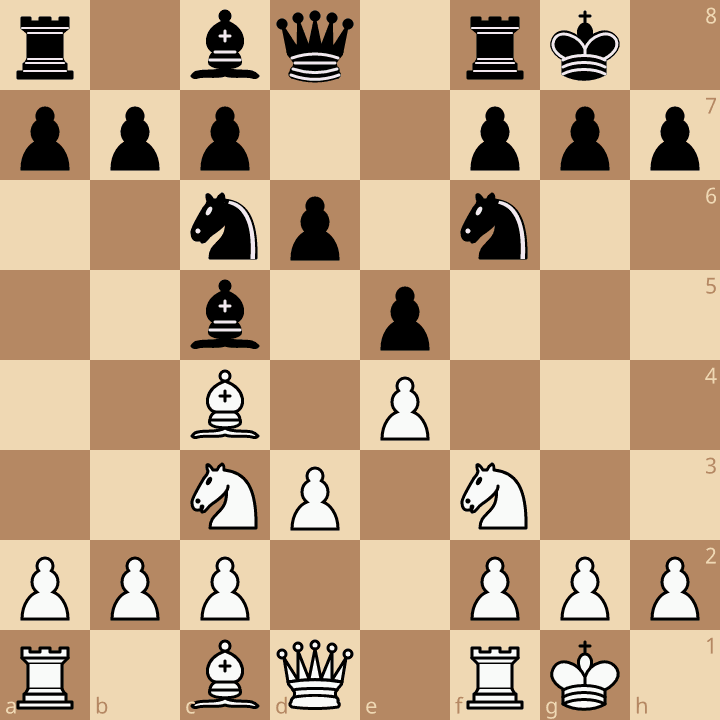
Famous Discovered Attack Examples
The Opera Game (Morphy vs. Duke of Brunswick, 1858)
Paul Morphy’s immortal Opera Game contains a discovered attack in its final combination. After 16. Qb8+! Rxb8 17. Rd8#, the rook on d1 delivers checkmate, having been revealed by the queen’s sacrifice. The queen sacrifice itself is a deflection, but the mating mechanism is a discovered attack along the d-file. This game, played in 1858 in a Paris opera box, is cited in virtually every chess tactics textbook.
Alekhine vs. Nimzowitsch, San Remo 1930
Alexander Alekhine’s positional mastery included deep understanding of discovered attacks. At San Remo 1930, Alekhine used a knight maneuver to uncover his bishop along the b1-h7 diagonal at a moment when Nimzowitsch had no time to reinforce the kingside, converting the discovered attack into a winning material advantage. The game contributed to Alekhine’s tournament victory with a score of 14/15 — one of the strongest performances in tournament chess history, finishing 3.5 points ahead of the field.
Fischer vs. Benko, US Championship 1963
Bobby Fischer’s crushing 11-0 sweep of the 1963 US Championship included several discovered attack themes. In his game against Pal Benko, Fischer set up a rook-bishop battery and used a knight leap to reveal the rook’s attack on Benko’s queen while the knight simultaneously forked two pieces. Benko had no response to both threats.
“When you see a good move, look for a better one. Often the better one is the discovery that was hiding behind it.” — Robert James Fischer, 11th World Chess Champion
How to Defend Against Discovered Attacks
Defending against discovered attacks is harder than defending against most tactics because two threats appear in a single move. The best defenses are preventive:
Avoid lining up your pieces with enemy long-range pieces. A rook on d1 pointing at your rook on d8 with only a pawn in between is a disaster waiting to happen. Keep valuable pieces off the same lines as enemy bishops, rooks, and queens.
Trade away the front piece. If you spot a potential battery, capture or exchange the front piece before it can step aside. No front piece means no discovery.
Keep your queen safe. The queen is the most common target of discovered attacks because it is the most valuable piece that can be “attacked for free” while the opponent deals with a discovered check. Keep the queen on squares where no opponent piece has a latent line pointing at it.
When already in a discovered attack: if you see both threats, decide which is more dangerous and deal with that one. Sometimes a counter-threat can muddy the waters, but usually material is lost and minimizing the damage is the practical goal.
Practice: Spot the Battery
Pattern recognition is the fastest path to seeing discovered attacks during games. The Lichess puzzle trainer offers discovered attack positions filtered by theme. At Shatranj Live, tracking your game history lets you review positions where you missed discovered attack opportunities or defenses.

Key Takeaways
- A discovered attack uncovers a hidden piece by moving the piece in front of it, creating two threats simultaneously.
- A discovered check is the strongest form: the opponent must respond to the check, leaving the second threat undefended.
- Building batteries — two pieces aligned along a rank, file, or diagonal — is how you create discovered attack potential.
- Famous games by Morphy, Alekhine, and Fischer all feature discovered attacks as decisive combinations.
- Prevent discovered attacks by avoiding lining your pieces with enemy long-range pieces and trading away front pieces when you spot a battery forming.
Explore more chess tactics at Shatranj Live or deepen your puzzle training with our Lichess Chess Puzzles: The Complete Tactics Guide. To learn more about the players who mastered discovered attacks, see the Bobby Fischer chess profile on Shatranj Live.

