

Not all chess tournaments are built the same. A 300-player open event in Mumbai runs on completely different logic than the eight-player Candidates field in Toronto. The format shapes everything: how pairings work, who advances, and whether the strongest player actually finishes first.
This guide breaks down every major chess tournament format used in FIDE events today, with examples from the tournaments Indian fans follow most closely.
 Photo: Stefan64, CC BY-SA 3.0 via Wikimedia Commons
The Swiss System: Chess for Large Fields
The Swiss system was designed for one problem: how do you run a competitive tournament with hundreds of players without anyone sitting out or getting eliminated? The answer is elegant. Every player plays every round. After each round, players with the same score are paired against each other. After N rounds, the player with the most points wins.
No one gets knocked out. A first-round loss does not end your tournament. Players who lose early still get competitive games against others at the same score level. This keeps everyone in the event and produces meaningful pairings throughout.
The Chess Olympiad is the most visible Swiss event in world chess. Teams from 180-plus nations compete over 11 rounds, with India sending both Open and Women’s teams. The FIDE Grand Swiss and the World Open also run on Swiss pairings. With fields this large, round-robin is simply not logistically possible.
The limitation is that Swiss pairings can be uneven. Two players who both score 7/9 may have beaten very different opposition. Tiebreaks (Buchholz, Sonneborn-Berger) try to account for this, but they are imperfect. Swiss is the right format for scale, not for deciding who is definitively the best player.
Round Robin: The Format That Finds the Best Player
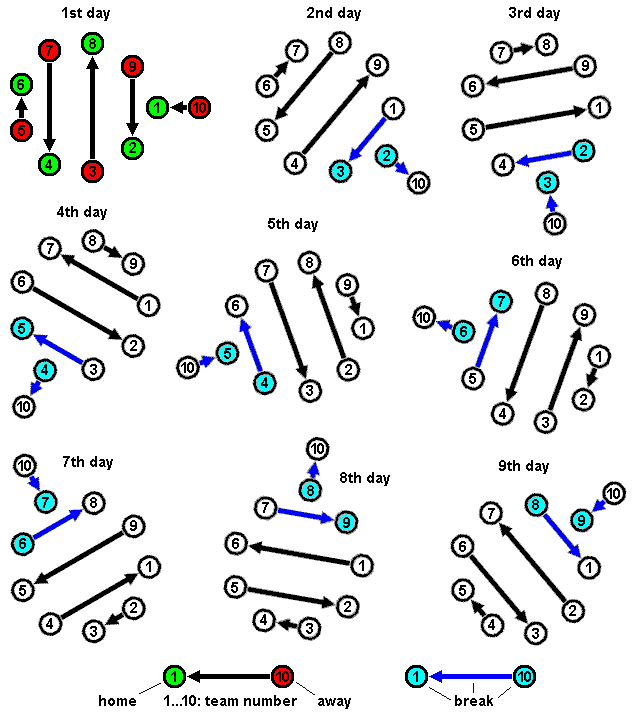
In a round-robin tournament, every player faces every other player exactly once. An eight-player field means seven rounds, and every result directly affects the final standings. There is nowhere to hide.
This is why the strongest supertournaments use round-robin. Norway Chess, Tata Steel Chess in Wijk aan Zee, the Superbet Classic in Bucharest, and the Sinquefield Cup in Saint Louis all use single round-robin with small fields of 8 to 10 players. Every head-to-head matters. The player at the top earned it against the full field.
Single round-robin does have one weakness. A bad day against one opponent can cost a title even if the player outperforms everyone else. That is exactly why the most important FIDE events step up to a stricter format.
“A round-robin is the most honest test in chess. Everyone plays everyone, and the player at the top has beaten — or at least outscored — the entire field. You cannot hide, you cannot get lucky brackets. It is pure.” — Magnus Carlsen, Five-time World Chess Champion and multiple Grand Chess Tour round-robin winner
Double Round Robin: The Gold Standard for Supertournaments
Double round-robin means each player faces every other player twice: once with White, once with Black. It is the most rigorous format in competitive chess.
The FIDE Candidates Tournament 2026 uses double round-robin. Eight players, 14 games each. The winner earns the right to challenge the World Chess Champion. With two games per pairing, one bad result can be corrected. Form over a full 14-game cycle reflects genuine strength far more accurately than any other format.
For India chess fans, this Candidates cycle is historic. Praggnanandhaa Rameshbabu (Pragg) is competing in the Open section. Vaishali Rameshbabu and Divya Deshmukh are in the Women’s Candidates field. All three are playing 14 games of double round-robin chess at the highest level. You can read the full preview at Candidates Tournament 2026: Complete Preview.
Double round-robin is resource-intensive. It works for small elite fields where the stakes justify a long event. You would not run a 32-player open in this format. But for choosing the world’s next challenger, it is the correct tool.
“The double round-robin is how we ensure the Candidates produces a worthy challenger. Fourteen games against seven opponents — with both colours — means there is no ambiguity about who played the best chess over the course of the event.” — Arkady Dvorkovich, FIDE President
Knockout: Drama Over Precision
Knockout tournaments, also called elimination brackets, work on a simple principle: lose and you go home. Players are seeded into a bracket. Each match eliminates one player. The last one standing wins the title.
FIDE uses knockout format for the World Cup, one of the largest and most dramatic events in chess. The American Cup also uses a knockout structure. With 200 players entering a World Cup, knockout is the only format that compresses the field into a manageable timeline.
The trade-off is significant. One bad game, one off day with the clock, and a top-10 player is on a flight home. The 2023 World Cup saw Magnus Carlsen eliminated in the quarterfinals despite being the highest-rated player in the field. Knockout rewards consistency over a short match, not over a long campaign.
Some events use double elimination, where a player must lose twice before being removed. This softens the luck factor somewhat, but most FIDE knockouts are single elimination.
The World Cup does serve a critical function beyond drama: it awards Candidates spots. Several World Cup finishers qualify for the Candidates Tournament each cycle, making the knockout format a gateway to the most rigorous one.
Armageddon: The Tiebreak That Ends All Draws
Classical chess ends in a draw more often than casual fans expect. Supertournaments need a decisive result, and the tiebreak ladder is designed to produce one.
When classical games are drawn, rapid games follow. If rapid games are also drawn, blitz games are played. If blitz draws, Armageddon is the final resolution.
Armageddon is a single decisive game with an asymmetric time control. White gets more time on the clock. Black just needs a draw to advance. This means both sides play for a result. A draw is a win for Black. White must actually win to advance. There is no more draw offer, no stalemate on the result sheet.
Norway Chess uses Armageddon after every drawn classical game. If the classical ends in a draw, the two players immediately play an Armageddon. A classical win is worth 3 points. An Armageddon win after a drawn classical earns 1.5 points for the winner and 1 for the loser. This scoring system deliberately rewards decisive classical play while still producing a result every round.
For a deeper look at the Candidates format and why it matters so much, see What Is the Candidates Tournament?.
Which Format Does the FIDE Candidates Tournament Use?
The FIDE Candidates Tournament 2026 uses double round-robin. Eight players in the Open section, eight in the Women’s section. Each player plays 14 games total: two against each opponent, one as White and one as Black.
This makes the Candidates the most rigorous format in chess outside of the World Chess Championship match itself. The winner of each section earns the right to challenge the reigning World Champion in a 14-game title match.
Pragg is India’s best shot at the Open title. Follow live standings at the Candidates 2026 and track his round-by-round performance at Praggnanandhaa Player Profile. Vaishali and Divya are competing in the Women’s section under the same format.
The full FIDE rules for tournament pairings, tiebreaks, and eligible formats are documented in the FIDE Handbook. It is worth reading if you want to understand exactly how pairings are calculated in Swiss events or how Buchholz tiebreaks work.
Follow Every Major Chess Tournament Format Live
Each structure tells you something different about the players competing. Swiss scales to any crowd. Round-robin reveals consistency. Double round-robin finds the best player over time. Knockout produces heroes and heartbreaks. Armageddon ends the night with a result.
Knowing the structure changes how you read the standings. A player at 5/7 in a Swiss field is doing well, but they may have faced easier opposition than expected. A player at 5/7 in a round-robin has beaten most of the field directly.
Follow every major FIDE supertournament on Shatranj Live with live standings, round results, and game replays updated automatically. Check the FIDE top players page to see current ratings for everyone competing in the 2026 Candidates field.


