

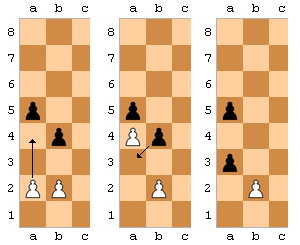
You’re mid-game, everything is going well, and then your opponent does something that stops you cold. Their pawn captures yours — diagonally — but lands on an empty square. No piece was there. The board looks wrong. What just happened?
What happened was en passant: the rarest, most confusing, and most frequently disputed rule in all of chess. Players argue about it in club games, beginners swear it’s illegal, and even experienced players occasionally forget it exists.
Once you understand it, you’ll wonder how you ever played without it. This guide breaks down exactly what en passant is, why it exists, how to use it, and when not to.
What Is En Passant?
En passant is a special pawn capture that allows your pawn to capture an enemy pawn that has just moved two squares forward — even though that enemy pawn has moved past the square where the capture would normally occur.
The phrase “en passant” is French, meaning “in passing”. That translation is the key to understanding the rule: you are capturing the pawn as it passes by, as though it had only moved one square instead of two.
Here is the basic scenario: your pawn is on the fifth rank (the halfway point of the board, from your perspective). Your opponent’s pawn is on an adjacent file, still on its starting square. On their turn, they push that pawn forward two squares — and it lands right beside yours. Under normal rules, you would have no way to capture it. But en passant gives you the right to take it anyway, moving your pawn diagonally to the square that enemy pawn skipped over.
It sounds strange. It is strange. But it is 100% legal, and it has been part of chess for over five centuries.
The rule is codified in FIDE Laws of Chess, Article 3.7(d). According to the FIDE Laws of Chess:
“A pawn occupying a square on the same rank as and on an adjacent file to an opponent’s pawn which has just advanced two squares in one move from its original square may capture this opponent’s pawn as though the latter had been moved only one square.”
— FIDE Laws of Chess, Article 3.7(d)
That single sentence is the complete legal definition. Every condition you need to know is embedded in it.
The Step-by-Step Rules
En passant is precise. The rule has no wiggle room — every condition must be met, or the capture is not allowed.
1. Only pawns can use en passant. No other piece in chess — not the knight, not the bishop, not the queen — can execute an en passant capture. This rule applies exclusively to pawns capturing pawns.
2. Your pawn must be on the fifth rank. For White, that means your pawn must have already advanced to the 5th rank. For Black, your pawn must be on the 4th rank. If your pawn is anywhere else on the board, en passant does not apply.
3. The enemy pawn must have just moved two squares. The opponent’s pawn must have moved from its starting square — its original second rank — all the way to the fourth rank (or fifth rank for Black) in a single move. If they moved the pawn one square earlier and one square now, en passant does not apply. It must be a two-square advance in one move.
4. The two pawns must be on adjacent files. Your pawn and the enemy pawn must be side by side after the two-square advance — on neighboring files, sitting on the same rank.
5. You must capture immediately. This is the rule that trips people up most often. You have exactly one opportunity to take en passant: the move immediately following the two-square advance. If you play any other move first, the right to capture en passant disappears permanently for that pawn. You cannot come back to it a move later.
How the capture works: Your pawn moves diagonally forward — one square — to the square that the enemy pawn passed through. The enemy pawn is removed from the board, even though your pawn does not land on the square it occupied.
You can practice spotting en passant positions interactively on Lichess’s free learn module and the Chess.com rules guide, both of which include visual examples.
Why Does En Passant Exist? The History Behind the Rule
To understand why en passant exists, you need to go back to 15th-century Europe.
For most of chess’s history — the game originated in India around the 6th century as chaturanga — pawns could only move one square forward at a time. Opening play was slow and strategic positioning happened gradually.
Around 1490, as chess spread through Spain and Italy, players introduced a new rule to speed up the game: pawns could now move two squares forward on their very first move. This is documented in the earliest surviving printed chess book, Luis Ramírez de Lucena’s Repetición de Amores y Arte de Ajedrez (c. 1497). The two-square pawn advance and en passant were codified together, making them inseparable rules from the very start.
But the two-square advance created an immediate problem. A pawn that had advanced to the 5th rank — well-positioned to control the center — could now be “skipped over” by an enemy pawn moving two squares. Under the old rules, that two-square advance was impossible, so the 5th-rank pawn would have had a chance to capture the advancing pawn when it reached the adjacent square. With the new rule, that capture opportunity simply vanished.
En passant was the solution. It preserved the strategic reality that existed before the two-square advance was introduced. If the enemy pawn had moved one square at a time, your 5th-rank pawn could have captured it. En passant says: you can still capture it, because that is how the game would have unfolded under the old rules.
In short, en passant is a fairness rule — a patch applied to chess in the late 15th century that kept the game balanced after a major rule change. The rule has remained unchanged in the FIDE Laws of Chess since the organization was founded in 1924 and has appeared in every edition of the Laws since.
Chess educator and author Jeremy Silman describes the logic plainly in How to Reassess Your Chess:
“En passant isn’t a loophole — it’s a logical extension of pawn capture rights that existed before the two-square advance was permitted. The rule restores parity.”
For a deeper look at how chess’s foundational rules evolved, see our history of shatranj — the ancient predecessor to modern chess.
When to Use En Passant (Strategy)
En passant is not just a curiosity — it is a real strategic tool. Knowing when to use it can change the outcome of a game.
Break up a pawn chain. Doubled pawns or connected pawn chains can be difficult to challenge. En passant often provides the only opportunity to disrupt a solid pawn structure, particularly when your opponent advances a pawn two squares to avoid an exchange.
Open a file for your rook. When you capture en passant, you change the pawn structure on both sides. The resulting open or half-open file can be immediately useful for a rook or queen that was previously blocked.
Avoid falling behind in the center. If your opponent pushes a pawn two squares to establish central control, en passant may be the cleanest way to contest that control immediately — without spending additional moves maneuvering other pieces.
Tactical combinations. In complex positions, en passant can be part of a deeper combination. Capturing en passant can expose a king, create a passed pawn, or set up a discovered attack. Always look a few moves ahead before deciding whether to take.
To see how top players navigate these exact pawn decisions in real time, watch grandmasters use these tactics in the Candidates 2026 — where opening preparation and pawn play at the highest level are on full display.
When NOT to Take En Passant
Just because you can capture en passant does not mean you should. Here are situations where declining is the stronger move.
When it weakens your own pawn structure. Taking en passant moves your pawn to a new file. If that leaves your original file with a weakness, or creates an isolated pawn, the capture may cost you more than it gains.
When you have a stronger move available. The temptation to use en passant can distract from a more powerful option — a checkmate threat, a winning tactical sequence, or a piece that desperately needs to move. En passant should serve your plan, not replace it.
When the resulting position benefits your opponent. After en passant, your pawn’s position changes. If that new square is hard to defend, or if your opponent has prepared a response to the capture, think twice.
When it gives your opponent a tempo. Sometimes taking en passant forces your pawn into a passive position, and your opponent uses the resulting structure to launch an attack. Calculate the resulting position carefully before committing.
En Passant in Famous Games
En passant appears throughout chess history, occasionally at decisive moments in elite competition.
Karpov and Spassky met in the semifinal of the 1974 Candidates Tournament in Leningrad — a match Karpov won 4–1 in classical games. Their games are studied for precise pawn play and long-term positional technique of exactly the kind that en passant enables. The complete game scores are available on Wikipedia’s en passant article and ChessGames.com for anyone who wants to examine the specific positions.
More recently, en passant has appeared in computer-engine analysis as the objectively best move in positions where human players routinely missed it — a reminder that even strong players can overlook the rule under time pressure.
The deeper lesson from these games is that en passant is never incidental. When top players use it, it is because they have calculated that the resulting pawn structure is favorable. It is a disciplined, purposeful move, not a reflex.
For more on special pawn and piece rules that shape these high-level games, read our guide on what castling is in chess — another rule that confuses beginners but defines grandmaster play.
How to Spot En Passant Opportunities
Training yourself to recognize en passant opportunities takes a little practice. Here is a simple mental checklist to run through after your opponent moves a pawn two squares.
Step 1: Check your pawn’s rank. Is any of your pawns on the 5th rank (for White) or 4th rank (for Black)? If not, en passant is impossible.
Step 2: Check adjacency. Did the two-square pawn land directly beside one of your 5th-rank pawns? It must be on an adjacent file — immediately to the left or right.
Step 3: Is this your next move? You only have one move to act. Before you respond to anything else on the board, ask yourself whether en passant is available and whether you want to take it.
Step 4: Calculate the resulting position. If all conditions are met, run through the consequences quickly. Where does your pawn end up? What does the pawn structure look like? Is it better or worse for you?
Step 5: Decide. Take en passant if it improves your position, advances your plan, or neutralizes a threat. Decline it if a stronger move exists or if the resulting structure is unfavorable.
With practice, this checklist becomes automatic. You will start noticing en passant opportunities the moment your opponent completes their two-square advance.
If you are building your overall chess foundation, our beginners guide to how to play chess covers every fundamental rule — including how en passant fits into the broader game.
Frequently Asked Questions
What does en passant mean in French? “En passant” translates directly to “in passing” in French. The name describes the nature of the capture: you are taking the enemy pawn as it passes by the square where you could have captured it if it had moved only one square.
Can any piece use en passant? No. En passant is exclusively a pawn rule. Only a pawn can capture en passant, and only an enemy pawn can be captured this way. No other pieces — not the knight, rook, bishop, queen, or king — can perform or be subject to an en passant capture.
Do you have to take en passant? No, en passant is never forced (except in a handful of chess variants with special rules). You always have the choice to decline the capture and play a different move. However, if you choose not to take en passant on the immediate next move, you permanently lose the opportunity for that specific pawn pair.
Can en passant happen more than once in a game? Yes. There is no limit to the number of times en passant can occur in a single game. Every time an opponent’s pawn advances two squares beside one of your 5th-rank pawns, the opportunity arises again. In theory, en passant could occur multiple times in the same game — though it is uncommon in practice.
Is en passant a forced move? No. En passant is always optional. You may take the capture or decline it — the choice is entirely yours. The only restriction is timing: if you want to take en passant, it must be done immediately, on the very next move after the two-square advance.
Where is en passant defined in official rules? En passant is defined in FIDE Laws of Chess, Article 3.7(d). The full Laws of Chess are published on fide.com and updated periodically by FIDE’s Rules Commission. The rule has not changed in substance since FIDE’s founding in 1924.
En passant is one of those chess rules that seems baffling the first time you encounter it, but makes complete logical sense once you understand its origins. It is not an arbitrary quirk — it is a carefully designed rule that preserved the strategic balance of the game when pawns gained the ability to sprint two squares on their first move in 15th-century Spain. Once you internalize when and why to use it, en passant becomes a quiet but powerful weapon in your arsenal. The best players in the world treat it as second nature. With practice, you will too.

